


In today’s digitally dominated world, businesses handle huge quantities of data through various business systems like ERP, CRM, accounting software, ecommerce and more. For many businesses, the challenge lies in managing this flow of data, maintaining accuracy and efficiency wherever employees need to interact with business data.
 1. The platform doesn’t offer hybrid integrations.
With the rise in cloud-based applications in every area of business, many modern integration platforms are built for cloud-only integrations. If your business still uses a mix of cloud-based and on-premise solutions, these platforms may not be suitable. Businesses of this nature should ensure that their chosen platform is hybrid integration friendly.
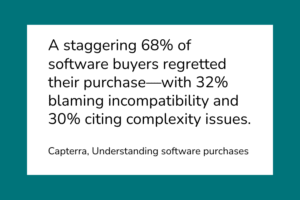
Don’t become part of the statistics: “A staggering 68% of software buyers regretted their purchase — with 32% blaming incompatibility and 30% citing complexity issues.” Capterra
 2. The integrations require in-house technical skills.
For many businesses, the aim of integrating systems is to reduce time spent on manual administration and data handling. Choosing an unmanaged labour-intensive integration platform with self-made workflows removes the focus from handling data and simply replaces this task with managing the integration itself. Many customers may prefer to choose a managed integration, where a team of experts set up and oversee your connections, freeing teams to focus on high-value business growth related tasks.
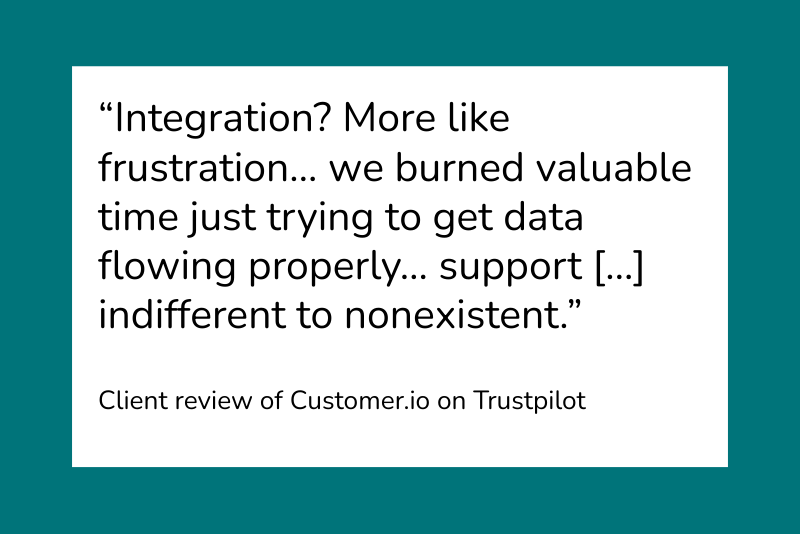
Beware the perils of DIY integration platforms: “Integration? More like frustration… we burned valuable time just trying to get data flowing properly… support […] indifferent to nonexistent.” Trustpilot
3. The platform doesn’t offer additional support or training.
With many modern integration platforms, support is not given as standard. Working through any issues with the integration can be time-consuming and confusing for teams, and in the worst-case scenarios, require external consultancy to fix. Users can benefit from having integration-related training and a team of dedicated support staff on call to handle any issues that may arise.
Make sure to partner with a company you can rely on: “Locked into a contract for a platform we can’t use… platform has not been functioning for over a month… Support has been slow, dismissive…” Trustpilot
4. The platform isn’t flexible or scalable.
As your business grows, you may accumulate more platforms and data entry points, or have a sharp increase in data volumes. It’s important to ensure that your integration platform is built to grow with your business. Asking the following questions can help you to identify if an integration platform is suitable:
- Is there a limit to how much data I can transfer/automate?
- Is there a limit to how many systems I can integrate to?
- Does the platform have the bandwidth to handle our increase in transactions?
Understanding the scalability of your integration platform can help to make it a long-term solution, and help you to avoid having to replace or upgrade this system if your business experiences a period of growth.
5. The product is not continuously developed or updated.
When choosing an integration platform provider, it’s important to consider whether they continuously develop and update the product to avoid vulnerabilities. If not, this could indicate that your chosen product may not be supported in future, or could be left open to security threats or performance issues.
Choosing the right integrations platform to suit your unique business requirements can be a difficult endeavour. There are many things to consider to avoid from falling victim to common integration pitfalls, such as a lack of on-premise connectivity, complex hands-on integrations, a lack of training and support, inflexible platforms or under-serviced solutions. If you would like tailored advice on ensuring that your integration set up meets the unique requirements of your business, you can reach out to our integration experts today, or find out more about our integration process on our website.
Comments are closed.